
Website Uptime Monitoring: How to Detect Downtime Before Your Customers Do
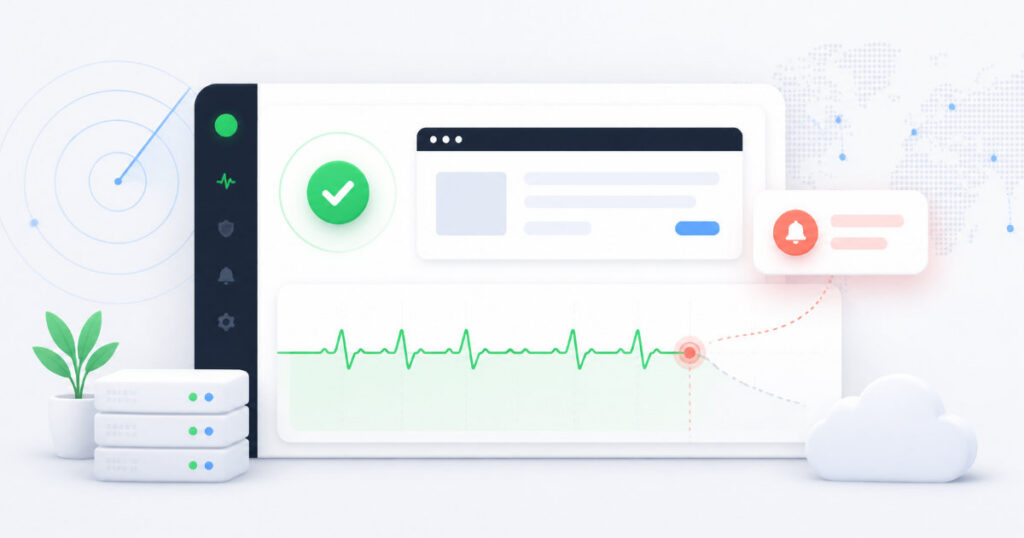
A website can be unavailable for several minutes before anyone on your team notices. A server may stop responding, a deployment may introduce an error, an SSL certificate may expire, or a third-party service may fail.
For customers, the reason does not matter: if they cannot access your website, sign in, complete a purchase, or use an important feature, the experience is broken.
Website uptime monitoring helps you detect those problems automatically. Instead of waiting for a customer report, your monitoring service regularly checks your website and alerts you when something goes wrong.
What is website uptime monitoring?
Website uptime monitoring is the automated process of checking whether a website or online service is reachable and responding correctly.
A monitoring service sends requests to a selected URL at regular intervals. If the site does not respond, returns an unexpected error, or takes too long to respond, the service records the failed check and can notify your team.
When the service becomes available again, the monitoring tool can also record the recovery and send a confirmation alert.
The goal is simple: know about outages quickly, understand how long they lasted, and reduce the time customers are affected.
Why downtime often goes unnoticed
Many teams discover outages too late because they rely on manual checks or customer messages.
That approach creates several problems:
- Your team may be offline when the outage begins.
- A broken page may affect only some users or locations.
- A website can appear to work for an administrator while failing for visitors.
- Customers may leave before reporting the issue.
- Support requests can arrive after revenue, trust, or sign-ups have already been affected.
Even a short outage can matter. If a visitor reaches an unavailable landing page, checkout page, or sign-in page, they may not return. For a SaaS product, a failed login or unavailable dashboard can immediately affect active customers.
Uptime monitoring gives your team an independent signal that something needs attention.
How uptime monitoring works
A typical uptime check follows a simple process:
- A monitoring service sends an HTTP or HTTPS request to your chosen URL.
- It waits for a response.
- It checks whether the response matches the expected result.
- It records the response time and status.
- If repeated checks fail, it marks the service as unavailable and sends an alert.
- When checks start succeeding again, it records a recovery event.
For example, you may monitor:
- Your public homepage
- A sign-in page
- A registration page
- A checkout page
- An important API endpoint
- A status page
- A customer dashboard URL
The monitoring tool should check the services that matter most to users, not only the server itself.
What website uptime monitoring can detect
Website uptime monitoring can help identify several common problems.
Server or hosting outages
If your server is down, overloaded, or unreachable, visitors may see an error page or no response at all. An uptime check can detect that the website is not available and alert your team.
Deployment failures
A new release can introduce a configuration issue, broken dependency, database connection problem, or application error. Monitoring helps you spot the problem shortly after deployment instead of discovering it through customer reports.
Domain and DNS issues
A domain configuration change, expired DNS record, or incorrect routing rule can make a site unavailable even when the server itself is working correctly.
SSL certificate problems
If an SSL certificate expires or is misconfigured, browsers may warn visitors that the website is not secure. Monitoring certificate validity helps you act before that warning appears.
Unexpected HTTP errors
A page may still load, but return an error such as 500 Internal Server Error, 502 Bad Gateway, or 503 Service Unavailable. Monitoring expected response codes helps distinguish a healthy page from a failing one.
Slow responses
A service can technically be online while still delivering a poor experience. A page that takes several seconds to respond may cause visitors to leave before it finishes loading.
This is why uptime monitoring works best alongside response-time monitoring.
What to monitor first
If you are starting with uptime monitoring, begin with the URLs that are most important to customers and the business.
A practical first set of monitors could include:
- https://yourdomain.com/
- Your sign-in page
- Your registration or trial-signup page
- Your main application URL
- A public API health endpoint
- A key customer workflow, such as checkout or account creation
Do not create dozens of monitors immediately. Start with the paths where an outage would cause the most damage, then expand as your product and infrastructure grow.
For AliveMonitor, that could mean monitoring the public marketing website, the application login page, the registration page, and a suitable API health endpoint.
Choose an appropriate check frequency
Check frequency determines how quickly you can detect an outage.
A shorter interval means faster detection, but it can also produce more monitoring activity and alerts. A longer interval uses fewer checks but may delay detection.
A sensible approach is:
- Use frequent checks for sign-in, registration, payments, and critical APIs.
- Use a moderate interval for public marketing pages.
- Review the frequency as traffic, customer expectations, and infrastructure needs change.
The right frequency depends on how costly downtime is for that service. A personal portfolio site and a customer-facing SaaS login page do not need the same monitoring strategy.
Set up alerts your team will act on
An alert is useful only if it reaches the right person and gives them enough information to respond.
For each monitor, decide:
- Who should receive the alert?
- Which channel should be used?
- How many failed checks should trigger an incident?
- Who needs to know when the service recovers?
- What should the recipient do first?
Email alerts are a good starting point for many teams. As your operations become more mature, you may also add channels such as Slack, incident-management tools, or on-call notifications.
Avoid alerting after a single failed request when possible. A temporary network issue can create a false alarm. Requiring repeated failed checks before creating an incident can reduce unnecessary notifications.
Do not forget recovery alerts
Recovery alerts are just as important as downtime alerts.
They tell your team that the service is responding again, help confirm that a fix worked, and provide a clearer incident timeline.
A useful incident record should show:
- When the failure was detected
- Which service was affected
- How long the issue lasted
- When the service recovered
- Whether follow-up work is needed
Over time, this history helps identify recurring problems and improve reliability.
Common uptime-monitoring mistakes
Monitoring only the homepage
Your homepage may work while sign-in, registration, checkout, or API requests fail. Monitor the user journeys that matter most.
Treating every 200 OK response as healthy
A successful HTTP status does not always mean the page is useful. An API may return 200 OK with an error message, incomplete data, or an unexpected response body.
For important services, combine uptime checks with API monitoring that validates the expected response.
Sending alerts to nobody
A monitor without a notification plan only records the problem after the fact. Make sure alerts go to a person or team who can investigate them.
Creating too many alerts
Monitoring every non-critical page at a very short interval can create noise. Start with the essential services and expand deliberately.
Ignoring response times
A slow service may frustrate customers even if it never becomes fully unavailable. Track response times to identify performance issues early.
A simple uptime-monitoring checklist
Before publishing or launching a service, confirm that you have:
- A monitor for the public website
- A monitor for the login or customer-access page
- A monitor for registration or conversion-critical pages
- A monitor for important APIs
- Alerts configured for the right team members
- Recovery notifications enabled
- A process for responding to incidents
- A record of downtime and recovery events
- Response-time tracking for critical services
Detect problems before customers do
Website uptime monitoring is one of the simplest ways to improve the reliability of an online service.
It does not prevent every outage, but it reduces the time between a failure starting and your team becoming aware of it. That faster detection gives you a better chance to respond before customers are affected for too long.
Start by monitoring the pages and services your users rely on most. Then use incident history and response-time data to make your monitoring coverage more useful over time.
Ready to get started? Visit: https://app.alivemonitor.com/register
Learn more about AliveMonitor’s features: https://alivemonitor.com/features/